Summary Reading of HTML from
Chapter 4: Ch.4 “Links” (pp.74-93) Chapter 15: “Layout” (pp.358-404) Chapter 3 (first part): “Functions, Methods, and Objects” (pp.86-99 ONLY)
Links
What is it?
links they allow you to move from one web page to another — enabling the very idea of browsing or surfing there are many types of links : 1. Links from one website to another 2. Links from one page to another on the same website 3. Links from one part of a web page to another part of the same page 4. Links that open in a new browser window 5. Links that start up your email program and address a new email to someone
How to do this?
Links are created using the <a> element. Users can click on anything between the opening <a> tag and the closing
</a> tag. You specify which page you want to link to using the href attribute.
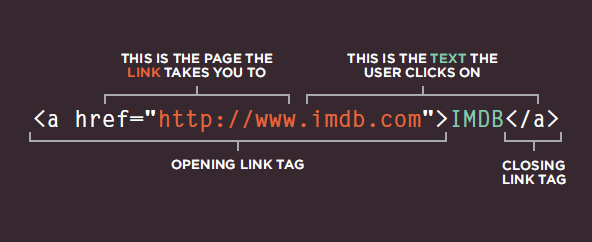
There are two types of URL ( Uniform Resource Locator) :
- relative URL : can be used when linking to pages within your own website.
- an absolute URL.
Email Links
To create a link that starts up the user’s email program and addresses an email to a specified
email address, you use the <a> element. However, this time the value of the href attribute starts
with mailto: and is followed by the email address you want the email to be sent to.
Layouts
- Fixed Width Layout : designs do not change size as the user increases or decreases the size of their browser window. Measurements tend to be given in pixels.
- Liquid layout : designs stretch and contract as the user increases or decreases the size of their browser window. They tend to use percentages.
- Grid Layout
Notes
<div>elements are often used as containing elements to group together sections of a page.- Browsers display pages in normal flow unless you specify relative, absolute, or fixed positioning.
- The float property moves content to the left or right of the page and can be used to create multi-column layouts. (Floated items require a defined width.)
- Pages can be fixed width or liquid (stretchy) layouts.
- Designers keep pages within 960-1000 pixels wide, and indicate what the site is about within the top 600 pixels (to demonstrate its relevance without scrolling).
- Grids help create professional and flexible designs.
- CSS Frameworks provide rules for commo- You can include multiple CSS files in one page.
Functions & Methods
complex scripts can run to hundreds (even thousands) of lines. Programmers use functions, methods, and objects to organize their code.
WHAT IS A FUNCTION?
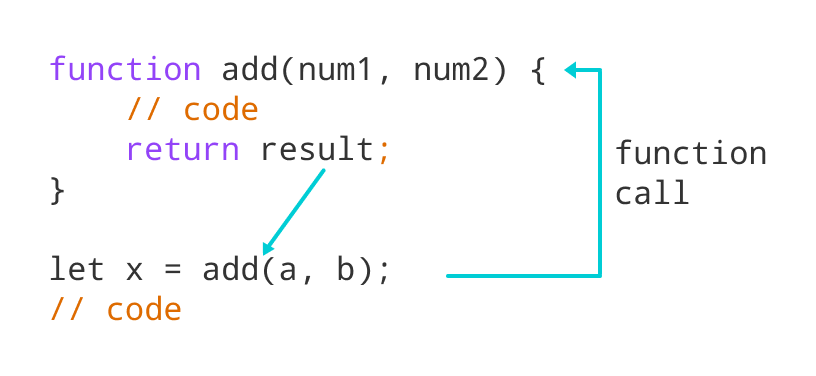
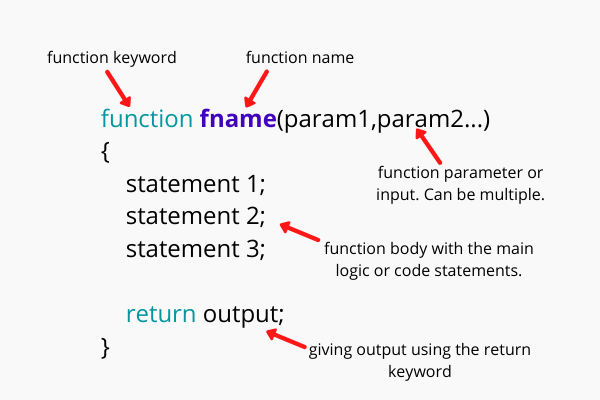
Functions let you group a series of statements together to perform a specific task. If different parts of a script repeat the same task, you can reuse the function (rather than repeating the same set of st atements).
HOW TO DECLARE IT?
HOW TO INVOKE IT?